What is a Part Marking Machine and How Does It Work?
In today's competitive manufacturing landscape, precision and traceability are paramount. A part marking machine plays a crucial role in achieving these goals. According to a recent report by MarketsandMarkets, the global part marking machine market is projected to reach $3.2 billion by 2026, with an annual growth rate of 5.8%. This highlights the increasing reliance on such machines across various industries, including automotive, aerospace, and electronics.
Part marking machines utilize advanced technologies like laser marking, inkjet printing, and dot peen marking. These machines ensure that components are labeled with identifying information, such as serial numbers and barcodes, which enhance product traceability and improve quality control. This level of detail helps manufacturers comply with rigorous industry standards. However, not all companies invest equally in these technologies; some still rely on outdated methods that can lead to errors.
Despite their benefits, companies must also reflect on the challenges of integrating part marking machines into existing processes. The initial investment and training can be daunting. Companies need to assess their specific needs carefully. When implemented correctly, part marking machines can significantly enhance operational efficiency and safety in the long run.

What is a Part Marking Machine? Understanding Its Definition and Purpose
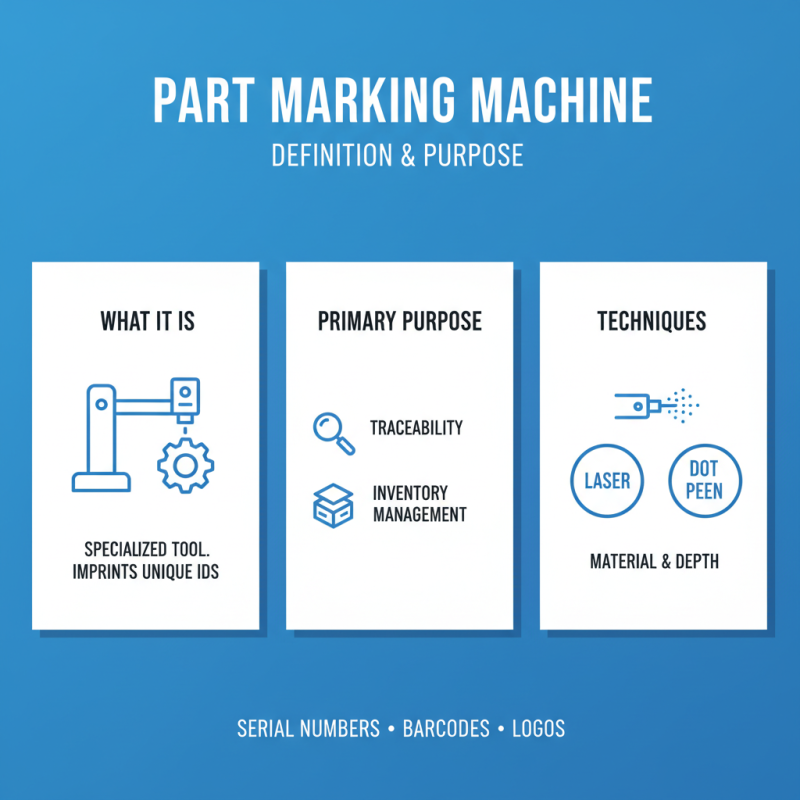
A part marking machine is a specialized tool used in various industries. Its primary purpose is to imprint unique identifiers, such as serial numbers and barcodes, directly onto parts or products. This process ensures traceability and improves inventory management. Such machines utilize different marking techniques, like laser or dot peen, depending on material and depth requirements.
Understanding the operation of a part marking machine is essential. Users should know the specific material traits for effective marking. For example, harder metals may require more power. Yet, the learning curve can be challenging. Incorrect settings can lead to unclear markings, affecting product quality. Attention to detail is vital to achieve precise results.
Many operators may not fully grasp the maintenance needs of their machines. Neglecting regular checks can decrease efficiency and accuracy. Users might overlook the importance of cleaning lenses or calibrating machines. Continuous training and awareness help mitigate these issues. The knowledge gained from experience is invaluable in optimizing the marking process.
The Technology Behind Part Marking Machines: How They Operate
Part marking machines are critical in various industries. These machines utilize advanced technologies to inscribe identification marks on components. This process enhances traceability and quality control in manufacturing. A recent report by the International Organization for Standardization indicates that effective part marking can reduce errors in production by 25%.
The operation of part marking machines involves several techniques. Laser marking is one of the most popular. It uses focused laser beams to create permanent marks on various materials. This method is precise and is preferred in aerospace and automotive sectors. A study published in Industry Week noted that laser marking systems can achieve marking speeds of up to 60 characters per second. Inkjet and dot-peen marking are also widely used, but they can sometimes lead to smudging or fading, requiring careful calibration.
While technology has improved marking accuracy, challenges remain. Variability in materials can affect mark quality. Additionally, keeping machines properly maintained is essential for optimal performance. A failure to do so can lead to inconsistent markings, impacting production integrity. Industries must strive for regular assessments of their marking systems to ensure reliability in quality tracking.
Common Applications of Part Marking Machines Across Industries
Part marking machines are essential in various industries. They create identifying marks on components, ensuring traceability and authenticity. This feature is crucial in sectors like aerospace, automotive, and medical devices. In aerospace, every component requires a unique identifier. This helps maintain safety standards and track parts throughout their lifecycle.
In the automotive industry, these machines help in documenting parts for compliance. Each part can have a serial number or a barcode, allowing for easy tracking during production and after sales. Medical devices also benefit significantly from part marking. Regulatory compliance demands clear identification of every component, ensuring patient safety and recall capabilities.
Despite their advantages, some challenges exist. Variations in materials can affect mark quality. Operators sometimes struggle with the machine settings for different surfaces. Continuous training is necessary to address these issues. Ultimately, effective part marking is not just about technology. It's about understanding the needs of each industry. Balancing quality and efficiency remains a constant challenge.
Key Benefits of Using Part Marking Machines in Manufacturing
Part marking machines play a crucial role in modern manufacturing. They ensure that every part is traceable through clear identification. This traceability can help companies maintain quality control and improve customer trust. Moreover, these machines allow for various marking methods, such as laser marking or dot peening, adapting to different materials and production demands.
The key benefits of using part marking machines include efficiency and accuracy. With automation, these machines reduce human error, speeding up production times. Notably, they can engrave intricate designs on parts, making them more identifiable. This precision can enhance brand reputation and decrease the risk of product recalls. Additionally, using part marking machines can streamline inventory management. Accurate part marking ensures that businesses track components easily, reducing the likelihood of misplacing materials.
However, it’s essential to recognize that implementing new technology may face challenges. The initial investment in part marking machines can be significant. Training staff to operate these machines properly is another hurdle. A lack of technical knowledge may lead to operational mishaps. Understanding these potential issues is vital for a successful integration of part marking technology in manufacturing processes.
What is a Part Marking Machine and How Does It Work? - Key Benefits of Using Part Marking Machines in Manufacturing
| Feature |
Description |
Benefits |
| Types of Marking |
Laser engraving, dot peen marking, inkjet printing |
Versatility in marking options for various materials |
| Speed |
High-speed marking for increased production efficiency |
Reduces cycle times and boosts output |
| Accuracy |
Precision marking with tight tolerances |
Enhances product traceability and quality control |
| Materials |
Compatible with metals, plastics, ceramics, and glass |
Widens the range of use across industries |
| Software Integration |
Compatible with CAD and ERP systems |
Streamlines workflow and data management |
| Maintenance |
Low maintenance requirements for reliable operation |
Minimizes downtime and operational costs |
Industry Standards and Compliance in Part Marking Processes
In the manufacturing sector, part marking processes are vital. These processes help ensure traceability and compliance with industry standards. Various techniques, such as
laser marking,
inkjet printing, and
dot peening, are employed. Each method has specific applications and benefits. Understanding
compliance standards is essential for manufacturers.
Compliance with ISO and other industry standards is crucial. It ensures that marked parts meet safety and quality requirements. Regulations may vary by industry and location. Companies must stay updated on these regulations to avoid penalties. They should also consider the long-term implications of non-compliance, which can include costly recalls or
reputational damage.
Tips: When choosing a part marking machine, assess your production volume and marking requirements. Investing in the right technology can save costs over time. Always validate your marking processes to ensure they meet compliance standards. Review your marking methods regularly to identify areas for improvement.