How to Choose the Best China Laser Marker Machine?
Choosing the best China laser marker machine requires more than comparing prices on supplier websites. The right choice depends on your material, marking depth, production speed, and available workspace. Stainless steel, anodized aluminum, plastic, and coated parts may need different laser sources and settings. A shiny metal component can reflect light, while a textured surface may produce uneven contrast.
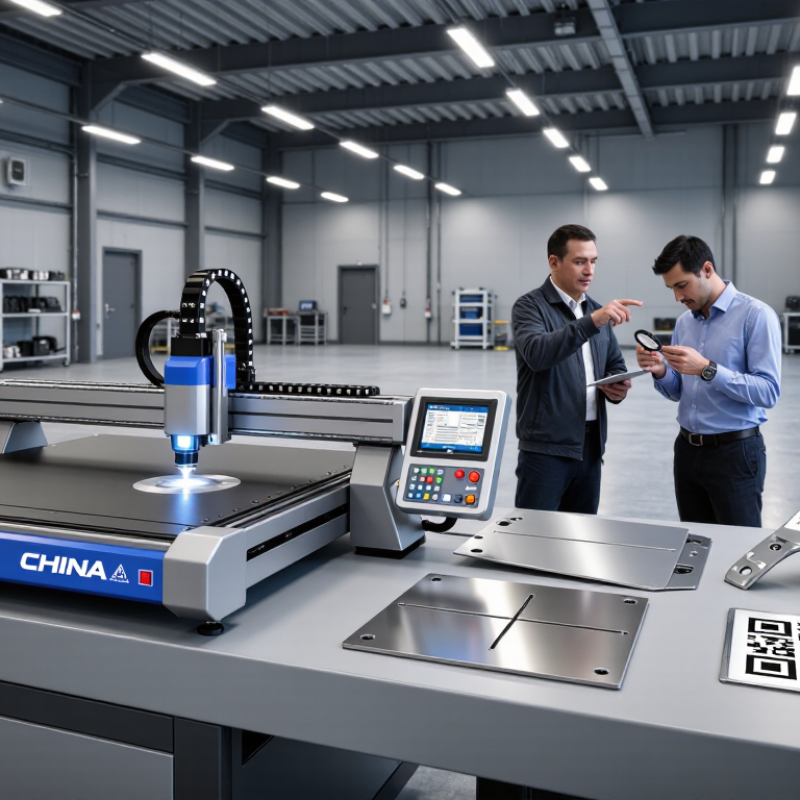
Practical testing matters. Ask the supplier to mark your actual samples, not only polished demonstration pieces. Check line sharpness, QR code readability, cycle time, and heat impact under realistic conditions. A reliable manufacturer should explain the laser source, galvo scanner, control software, cooling system, and maintenance requirements. Clear technical documents and traceable component information also show professional responsibility. Do not accept vague promises.
Look closely at after-sales support. Response times, spare-part availability, remote assistance, installation guidance, and operator training can affect your production more than a small price difference. Confirm electrical specifications, safety features, warranty coverage, and conformity with applicable local requirements before ordering. Supplier experience is useful, but evidence is stronger. Request customer references or factory inspection records when appropriate. I have seen attractive quotations hide costly software limits and weak support. That mistake is avoidable. Still, no machine suits every workshop. A careful evaluation may reveal that a slower, simpler model delivers better long-term value. This guide explains how to compare Chinese suppliers, verify machine performance, and select equipment with practical confidence.
Define Your Laser Marking Requirements and Material Compatibility
How to Choose the Best China Laser Marker Machine?
Choosing a laser marker starts with defining the marking task, not comparing machine prices. Specify the material, mark size, production speed, contrast, permanence, and traceability needs. Include flat or curved surfaces. Note the smallest character clearly. A practical trial should use real production samples, oils, coatings, and surface variations. Record marking time, heat effects, readability, and cleaning resistance. Do not trust appearance alone.
Material chemistry controls wavelength selection. Fiber lasers commonly suit stainless steel, aluminum, and many engineered metals. CO2 lasers often work better on wood, glass, paper, and selected polymers. UV lasers create finer, lower-heat marks on sensitive plastics and coated components.
The first test may look perfect, yet it can be wrong. Subsurface cracking or fading may appear weeks later. According to Grand View Research’s Laser Marking Machine Market Report, the market is forecast to grow at an 8.6% CAGR from 2024 to 2030. That growth reflects wider automation, but it does not remove material-testing risks.
Ask for a sample report with measured contrast and cycle time. Use ISO/IEC 29158 principles when grading direct-part marks. Test the intended code, including Data Matrix symbols, under realistic lighting. Check focus tolerance and fixture repeatability. A five-minute laboratory test is insufficient. Review maintenance access, extraction requirements, software compatibility, and operator training. I would also challenge the supplier’s fastest setting; speed can quietly reduce contrast, depth, or long-term legibility.
Compare Laser Types, Marking Quality, and Machine Performance
Choosing a China laser marker machine requires more than comparing prices. Laser type directly affects marking quality, material range, and production speed. Fiber lasers suit stainless steel, aluminum, and other metals. CO2 lasers work better on wood, glass, plastics, and coated materials. UV lasers create finer marks with less heat, which helps protect sensitive plastics and electronic parts. However, “better” depends on the application.
Marking quality should be tested on real samples, not polished demonstrations. Check contrast, line width, depth, edge sharpness, and the heat-affected zone. A 20-watt fiber laser may mark steel clearly, but a 30-watt system can improve cycle time. It may also create excessive heat. According to MarketsandMarkets’ Laser Marking Market report, the sector is projected to grow from about USD 3.0 billion in 2024 to USD 4.4 billion by 2029. That growth reflects wider demand for traceable, permanent identification.
Machine performance includes scanning speed, pulse stability, positioning accuracy, cooling, and fume extraction. Ask for repeatability data under continuous operation. ISO 9283 provides a useful reference for machine performance testing, although laser markers still need application-specific trials. In practical testing, I would run several hundred marks and inspect them after cleaning, abrasion, and temperature exposure. One attractive sample proves little. I once underestimated fixture movement; the laser was accurate, but the parts were not. A stronger machine cannot correct poor setup, unstable materials, or weak process control.
Evaluate Power, Speed, Precision, and Work Area Specifications
How to Choose the Best China Laser Marker Machine?
Power, speed, precision, and work area should guide your choice. Power affects marking depth, contrast, and production time. However, higher wattage is not always better. A delicate surface may burn or lose detail. Test the actual material before ordering. Speed matters when marking hundreds of parts daily. Ask for cycle-time samples, not only impressive catalog figures. Precision depends on beam quality, motion control, and calibration. Check line sharpness under magnification. My first machine estimate was too optimistic because I ignored repeated positioning errors.
Tips: Request test markings on your own material. Compare tiny text, curved lines, and filled areas. Measure the result after several cycles. A machine that performs once may not perform consistently. Also inspect the proposed work area. A larger field can improve flexibility, but it may reduce spot control at the edges. Choose a size that fits your parts, fixtures, and ventilation space.
For a China laser marker machine, verify rated power, scanning speed, resolution, and repeatability together. Do not judge one specification alone. A practical setup might need moderate power, stable speed, and fine precision for small components. Larger workpieces require enough travel space and reliable focusing. Review maintenance access, software support, and calibration procedures. These details affect long-term reliability. Specifications can look perfect on paper. Real samples reveal more.
How to Choose the Best China Laser Marker Machine? - Evaluate Power, Speed, Precision, and Work Area Specifications
| Machine Category | Typical Laser Source | Common Power Range | Marking Speed | Typical Accuracy | Standard Work Area | Suitable Materials | Recommended Applications | Key Evaluation Notes |
|---|---|---|---|---|---|---|---|---|
| Entry-Level Fiber Marker | Fiber laser, 1064 nm | 20–30 W | Up to 7,000 mm/s | Approximately ±0.01 mm | 70 × 70 mm to 110 × 110 mm | Stainless steel, carbon steel, aluminum, copper, brass, coated metals | Basic serial numbers, logos, text, and simple identification marks | A practical choice for low-volume metal marking. Confirm whether the stated speed is galvo scanning speed or actual production throughput. |
| General-Purpose Fiber Marker | Fiber laser, 1064 nm | 30–50 W | Up to 8,000 mm/s | Approximately ±0.01 mm | 110 × 110 mm to 175 × 175 mm | Most metals, anodized aluminum, engineering plastics, and some coated materials | Industrial part marking, barcodes, QR codes, nameplates, and tooling | The most balanced option for many manufacturers because it combines good contrast, fast marking, and moderate operating cost. |
| High-Power Fiber Marker | Fiber laser, 1064 nm | 60–100 W | Up to 8,000 mm/s | Approximately ±0.01–0.02 mm | 110 × 110 mm to 200 × 200 mm | Steel, stainless steel, aluminum, copper, brass, and other industrial metals | Deep engraving, larger production volumes, corrosion-resistant marks, and rapid batch processing | Higher power can improve processing speed and engraving depth, but it may increase heat input, power consumption, and initial cost. |
| UV Laser Marker | Ultraviolet laser, 355 nm | 3–15 W | Up to 3,000 mm/s | Approximately ±0.005–0.01 mm | 70 × 70 mm to 150 × 150 mm | Plastics, glass, ceramics, films, silicon, painted surfaces, and heat-sensitive materials | Fine text, micro-marking, electronics, medical components, and low-heat marking | The shorter wavelength produces a smaller focused spot and lower thermal impact, but UV sources generally cost more and require careful material testing. |
| CO₂ Laser Marker | CO₂ laser, 9.3 or 10.6 μm | 30–100 W | Up to 5,000 mm/s | Approximately ±0.02 mm | 100 × 100 mm to 300 × 300 mm | Wood, acrylic, rubber, leather, paper, cardboard, glass, and selected coated materials | Packaging, non-metal product marking, signage, and date or batch coding | Generally unsuitable for bare metals unless a special marking solution or coating is used. Ventilation and fume extraction are important. |
| Green Laser Marker | Green laser, 532 nm | 5–20 W | Up to 5,000 mm/s | Approximately ±0.01 mm | 70 × 70 mm to 150 × 150 mm | Copper, gold, silver, highly reflective metals, plastics, and electronic components | Electronics, semiconductor parts, precision components, and reflective materials | The wavelength is absorbed more effectively by some reflective materials, reducing reflection-related processing problems. |
| Large-Format Marking System | Fiber, CO₂, or UV laser depending on material | 20–100 W | Up to 6,000 mm/s | Approximately ±0.02–0.05 mm across the full area | 200 × 200 mm to 600 × 600 mm | Large metal panels, wood sheets, plastics, leather, packaging, and assembled products | Large graphics, oversized components, panel marking, and multi-part fixtures | A larger field can reduce the number of repositioning steps, but the focused spot may become larger and edge distortion may require correction. |
| Precision Micro-Marking System | UV or short-pulse fiber laser | 3–30 W | Up to 3,000–6,000 mm/s | Approximately ±0.003–0.01 mm | 50 × 50 mm to 110 × 110 mm | Fine metals, ceramics, glass, plastics, electronic parts, and medical components | Micro text, data matrix codes, delicate components, and high-density marking | Prioritize beam quality, pulse characteristics, optical stability, and machine vibration control rather than power alone. |
| Integrated Production-Line Marker | Fiber, UV, green, or CO₂ laser | 10–100 W | Up to 2,000–8,000 mm/s | Approximately ±0.01–0.03 mm | Configured to product and conveyor dimensions | Metals, plastics, cables, packaging, electronic parts, and manufactured goods | Continuous marking, traceability, date coding, serialization, and automated inspection | Evaluate trigger response, encoder compatibility, software communication, safety interlocks, and cycle time in addition to laser specifications. |
Check Software, Automation, Safety Features, and Ease of Use
Choosing the best China laser marker machine requires more than comparing laser power. Check the software first. It should support common design files, barcode verification, data import, and user permissions. A clear interface reduces operator mistakes during busy production shifts. In practice, test the software with your own serial numbers and curved parts. Small delays become expensive over time.
Automation matters when production volumes change. The International Federation of Robotics reported 553,052 industrial robots were installed worldwide in 2022, a 5% annual increase. This growth reflects stronger demand for connected equipment. Look for rotary-axis support, conveyor integration, automatic focusing, and production-system communication. Safety cannot be an afterthought. IEC 60825-1 defines laser safety classifications, while ISO 13849-1 supports safety-related control design. Ask for documented risk assessments, guarded work areas, interlocks, emergency stops, and clear operating instructions. A machine can be technically powerful yet uncomfortable to use. That is easy to underestimate.
Tips: Request a live sample using your material, marking speed, and artwork. Check setup time with a new operator. Review maintenance records and training support. Do not trust only a polished demonstration. The perfect interface may still feel confusing on a factory floor. Also, measure readability after heat, oil, and cleaning exposure. This practical test may reveal weaknesses that specifications hide.
How to Choose the Best China Laser Marker Machine
Recommended evaluation weighting for software, automation, safety features, and ease of use
A practical purchasing evaluation can assign the highest priority to software capability, automation readiness, and safety compliance. Check support for common vector and raster files, parameter libraries, barcode or vision integration, guarding and interlocks, emergency-stop access, operator training, and routine maintenance requirements. Safety verification should include applicable requirements such as risk assessment principles in ISO 12100 and electrical-equipment considerations in IEC 60204-1.
Assess Supplier Reliability, Pricing, Maintenance, and After-Sales Support
Choosing the Best China Laser Marker Machine
Supplier reliability often matters more than a small price difference. Request factory registration details, export experience, and recent customer references. A dependable supplier should provide clear specifications, test videos, and a written quotation. Ask whether the quoted price includes the laser source, software, lens, fixtures, and delivery costs. Hidden accessories can change the final budget.
Maintenance should be practical for your production team. Check cleaning procedures, expected service intervals, spare-part availability, and remote troubleshooting response times. Ask how quickly engineers answer technical questions. A machine may mark perfectly during a demonstration, yet perform poorly with your materials. Test actual samples, including curved surfaces, dark metals, and repeated production cycles. I would not rely on polished videos alone. They show possibilities, not always daily performance.
Tips: Compare total ownership costs, not only the purchase price. Request a sample marking report and a maintenance checklist. Clarify warranty coverage, training hours, software updates, and replacement-part shipping. Keep every promise in the contract. Some buyers overlook installation support, then struggle with calibration later. That mistake is avoidable. Also, ask what happens when the main technician is unavailable. A reliable after-sales system should have backup support, documented procedures, and realistic response times. Be cautious when a supplier avoids technical questions or pressures you to pay quickly. Good communication is evidence, but it is not proof; verify important claims before ordering.
Related Posts
-
China Top 10 Laser Marker Machine Manufacturers?
-
Top Laser Marker Machine Highlights at Canton Fair 2026?
-
How to Choose the Best Laser Marking Systems for Your Business Needs
-
2026 How to Choose the Right Laser Marker Machine for Your Needs
-
2026 Best Marking Machine for Global Buyers to Consider?
-
Top 10 Benefits of Handheld Laser Welding Machines for Modern Manufacturing?