Best China Robotic Welding Machine for Global Buyers?
Choosing the Best China Robotic Welding Machine for Global Buyers requires more than comparing prices and advertised specifications. Buyers need to examine welding quality, automation stability, service support, and long-term operating costs. A machine may look impressive in a catalog, yet perform poorly when handling changing joint designs, reflective materials, or uneven workshop conditions.
In practical factory evaluations, details often reveal more than brochures. Watch the robot repeat the same weld across several steel frames. Check bead consistency, arc stability, fixture alignment, and the time required for changeovers. Ask whether technicians can access replacement torches, sensors, cables, and control components without long delays. These points matter when production cannot stop. They also help buyers compare suppliers using measurable evidence instead of confident sales language.
No machine fits every factory. That is easy to forget. A compact six-axis system may suit automotive parts, while a heavier robotic welding cell may better support structural steel production. Buyers should review sample welds, operator training, safety functions, integration records, and documented acceptance tests. Supplier experience matters, but it should be verified through references, inspection reports, and clear warranty terms.
This guide explores reliable China-made solutions for international buyers. It considers technical capability, customization, installation, communication, and after-sales support. Some recommendations may require adjustment because factory layouts and workforce skills differ widely. That limitation is real. A careful purchasing decision balances performance, compliance, maintenance access, and total cost over the machine’s working life.
What Is a Robotic Welding Machine?
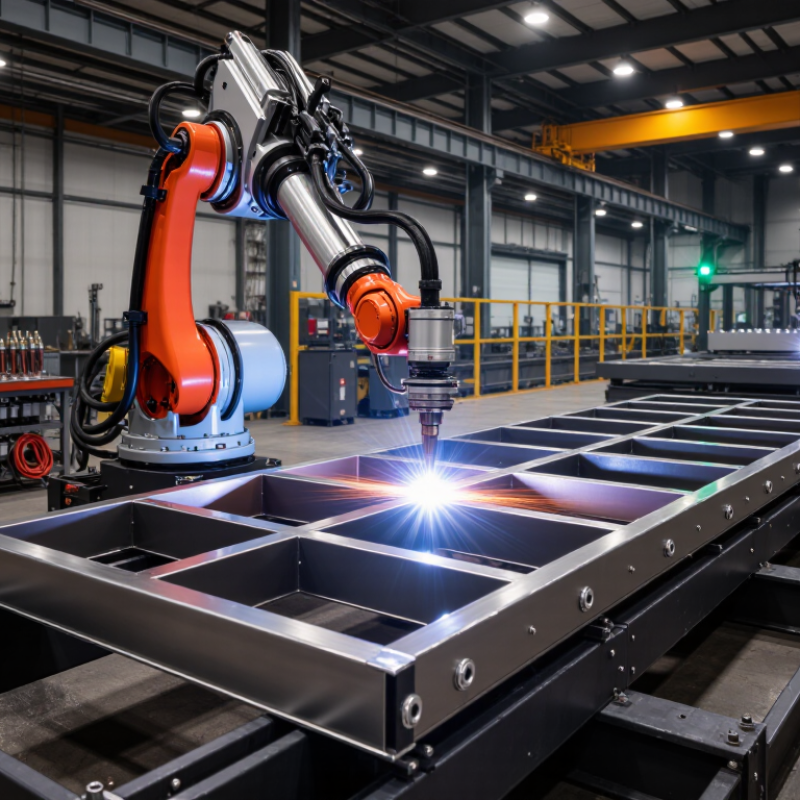
A robotic welding machine combines a programmable robot arm, welding power source, torch, controller, and workholding system. It moves the torch along defined paths with consistent speed and angle. Sensors may track seams, detect parts, or adjust welding conditions. A positioner can rotate the workpiece, helping the torch reach difficult joints. This system suits repeated production, especially when welds must look and perform consistently.
In practical testing, setup quality often matters more than robot speed. A poorly fitted joint can create gaps, spatter, or weak penetration. The robot repeats the programmed mistake very accurately. Operators still inspect fixtures, wire feeding, shielding gas, and torch alignment. Weld appearance alone is not enough. Qualified procedures, material checks, and documented inspections support safer purchasing decisions for global buyers. Requirements vary by industry and destination, so local compliance should be verified.
Tips: Ask for sample welds using your actual material and joint design. Measure cycle time, defect rate, maintenance access, and operator training needs. Check whether the control system supports your factory workflow. Also, leave room for human judgment. Automation reduces repetitive work, but it does not remove every welding problem. I have seen impressive demonstrations fail during longer production runs. That limitation deserves honest attention.
Key Technologies Used in Chinese Robotic Welding Systems
For global buyers, Chinese robotic welding systems increasingly combine lower-cost hardware with mature automation. The International Federation of Robotics reported 541,302 industrial robot installations worldwide in 2023. China accounted for about 276,300 units, representing more than half of global demand. This scale supports strong supply chains for robot arms, welding power sources, sensors, and controllers.
Key technologies determine real performance. Laser vision sensors scan joint gaps before welding and help correct torch position. Arc sensors adjust travel paths when steel distortion changes the seam. Servo-driven wire feeders stabilize deposition, especially during continuous fillet welds. Many systems also use offline programming and digital twins. Engineers can test torch angles, reach, and cycle times before stopping production. The effect is practical. A fixture can be checked on screen, not only beside a hot workpiece.
Safety depends on more than a robot enclosure. Modern cells may combine light curtains, interlocked doors, emergency stops, and speed monitoring. The IFR World Robotics 2024 report placed China’s robot density at 470 robots per 10,000 manufacturing workers in 2023. That figure shows adoption, but not welding quality. Real validation still requires sample welds, destructive testing, and traceable parameters. Market research from MarketsandMarkets estimates strong growth in the global robotic welding sector through 2029, driven by labor shortages and repeatability needs. However, a polished demonstration can hide poor cable routing or difficult maintenance. Buyers should inspect nozzle access, calibration records, software support, and spare-part response times. Small details matter.
How to Evaluate Welding Quality, Accuracy, and Productivity
Best China Robotic Welding Machine for Global Buyers?
How to Evaluate Welding Quality, Accuracy, and Productivity
A capable robotic welding machine should produce consistent beads, not merely impressive demonstration parts. Inspect penetration, bead width, spatter, distortion, and start-stop points. Use destructive tests when possible, including bend, tensile, and macro-section testing. ISO 9283 recommends measuring robot pose accuracy and repeatability under defined conditions. Ask for measured results, not marketing adjectives.
Accuracy must survive real production. Check torch calibration, fixture repeatability, wire-feed stability, and performance after several hours. A 0.1-millimeter claim means little if fixtures move during thermal expansion. Test different joint gaps and material batches. Include corners and awkward angles. They expose weaknesses.
Productivity includes uptime, changeover time, programming effort, and rework. The International Federation of Robotics reported 541,302 industrial robots were installed worldwide in 2023. Its World Robotics 2024 report also recorded China’s robot density at 470 units per 10,000 manufacturing employees. Automation is expanding, but speed alone does not guarantee value. Deloitte’s 2024 Smart Manufacturing and Operations Survey found 86% of manufacturers viewed smart manufacturing as important for competitiveness. That pressure can encourage rushed purchasing. I would request a timed sample run, with recorded arc-on time, cycle time, defect rate, and operator intervention. One uncomfortable truth remains: laboratory results may not match a dusty workshop. Test there.
| Evaluation Category | Standard 6-Axis MIG/MAG Cell | Dual-Station MIG/MAG Cell | Heavy-Duty Robotic Welding Cell | Recommended Acceptance Target |
|---|---|---|---|---|
| Typical Workpiece Range | Small to medium fabricated parts Up to approximately 1,200 mm |
Small and medium parts with frequent loading Up to approximately 1,500 mm |
Large frames, machinery components, and structural assemblies Approximately 1,500–3,000 mm |
Must match the largest planned workpiece with at least 10% clearance |
| Robot Payload | 6–12 kg | 6–20 kg | 12–25 kg | Payload should exceed torch, wire-feeder, dress pack, and tooling weight |
| Horizontal Reach | 1,400–2,000 mm | 1,400–2,200 mm | 1,800–3,000 mm | Reach must cover the complete weld envelope without operating at the mechanical limit |
| Position Repeatability | ±0.05–0.10 mm | ±0.05–0.10 mm | ±0.08–0.15 mm | Verify according to ISO 9283 under the intended payload and working range |
| Typical Welding Process | GMAW / MIG / MAG | GMAW / MIG / MAG with automatic part exchange | High-current GMAW, tandem welding, or submerged arc where applicable | Process must be qualified for the material, thickness, joint design, and required weld class |
| Common Material Thickness | 1.5–12 mm | 1.5–16 mm | 6–30 mm or more, depending on process and joint preparation | Confirm penetration, heat input, and distortion results through sample weld testing |
| Typical Welding Current | 50–350 A | 50–450 A | 100–600 A, depending on the power source and process | Power source duty cycle should support the required current continuously |
| Wire Diameter | 0.8–1.2 mm | 0.8–1.6 mm | 1.0–2.4 mm | Wire-feeding system must match the selected wire material and diameter |
| Welding Speed | 4–12 mm/s | 4–15 mm/s | 3–20 mm/s | Evaluate actual deposition rate and weld quality, not only the maximum travel speed |
| Arc-On Time | 35–55% | 50–70% | 40–65% | Measure during a complete production cycle, including loading, unloading, and repositioning |
| Positioning Efficiency | Single fixture; manual changeover | Two fixtures; one side can be loaded while the other side welds | Multi-axis positioner or turntable for complex parts | Use the configuration that minimizes non-welding time and operator waiting time |
| Seam Tracking | Optional touch sensing or laser sensing | Touch sensing, through-arc sensing, or laser sensing | Through-arc sensing or laser seam tracking for long or variable joints | Demonstrate tracking performance on realistic joint gaps and part tolerances |
| Weld Bead Consistency | Uniform bead profile when fixtures and joint gaps are controlled | Uniform bead profile with reduced changeover variation | Stable profile for long welds when heat input and wire delivery are controlled | Check bead width, leg length, penetration, undercut, porosity, and spatter against the WPS |
| Dimensional Accuracy | Typically dependent on fixture accuracy and part preparation | Typically improved through repeatable fixture positioning | Requires rigid tooling, controlled thermal distortion, and calibrated positioning | Measure completed assemblies using calibrated gauges or 3D inspection equipment |
| Fixture Changeover Time | Approximately 10–30 minutes | Approximately 1–10 minutes with prepared fixtures | Approximately 10–45 minutes, depending on workpiece size | Include fixture exchange, robot program selection, zero-point confirmation, and safety checks |
| Production Throughput | Suitable for stable medium-volume production | Suitable for mixed models and higher utilization | Suitable for large parts and long continuous welds | Compare good parts per shift, not only theoretical cycle time |
| Typical Utilization Potential | 60–75% during a stable production schedule | 70–85% with effective loading and fixture planning | 60–80%, depending on handling and part preparation | Confirm utilization using a production trial lasting at least one complete shift |
| Quality Verification | Visual inspection and dimensional checks | Visual, dimensional, and selected non-destructive testing | Visual, dimensional, ultrasonic, magnetic-particle, or radiographic testing as required | Inspection method must correspond to the applicable drawing, WPS, and weld quality standard |
| Applicable Standards | ISO 10218, ISO 9283, ISO 3834, AWS D1.1 where applicable | ISO 10218, ISO 9283, ISO 3834, AWS D1.1 where applicable | ISO 10218, ISO 9283, ISO 3834, EN 1090 or AWS D1.1 where applicable | Request certificates, calibration records, risk assessment, and weld procedure documentation |
| Safety Requirements | Fenced cell, interlocked gate, emergency stops, and welding fume extraction | Fenced cell, interlocked access, area scanners or light curtains, and fume extraction | Full perimeter guarding, access control, emergency stops, fume extraction, and fire protection | Complete a site-specific risk assessment before installation and commissioning |
| Best Fit for Global Buyers | General-purpose fabrication and repeatable parts | High-mix production where machine utilization is critical | Heavy fabrication requiring long welds and high deposition rates | Select based on total cost per accepted part, service support, spare parts, and operator training |
| Data note: The figures represent typical industrial ranges for robotic welding cells and should be validated through a production sample test. Actual results vary with material grade, joint design, fixture rigidity, weld procedure, operator loading time, part tolerances, and required inspection level. | ||||
Essential Features for Global Buyers to Compare
Best China Robotic Welding Machine for Global Buyers?
Global buyers should compare capability, not catalogue photos. The International Federation of Robotics reported 541,302 industrial robot installations worldwide in 2023. The same report recorded about 4.28 million robots operating globally. This scale makes compatibility and serviceability critical purchasing factors.
Check payload, working reach, repeatability, and welding-position accuracy. A six-axis robot may look flexible, yet its wrist can struggle near deep fixtures. Request sample welds using your actual steel thickness, joint design, wire diameter, and shielding gas. Compare cycle time beside bead appearance, spatter, penetration, and rework rates. Numbers need context. A fast cycle is useless if operators must grind every seam.
Review controller languages, offline programming, remote diagnostics, and spare-part availability in your region. Confirm compatibility with power sources, positioners, fume extraction, and safety interlocks. ISO 10218 requirements should guide the robot-cell safety review, while ISO 9283 methods help verify positioning performance. The International Federation of Robotics also shows that manufacturing automation is expanding across many regions, so local training and support can affect uptime as much as hardware. A serious supplier should provide clear test conditions, electrical specifications, maintenance intervals, and acceptance criteria. I would not rely on a polished demonstration alone. Real factories are dusty, variable, and imperfect. That is where weak integration becomes expensive.
Export, Installation, Safety, and After-Sales Considerations
Best China Robotic Welding Machine for Global Buyers?
Export planning begins before the machine leaves the factory. Confirm the required voltage, frequency, language, and welding standards with your local engineer. Ask for a complete packing list, commercial invoice, origin documents, and accurate customs classification. Wooden crates should be treated and clearly marked for lifting. Small documentation errors can delay delivery.
Installation needs more than placing the robot beside a welding table. Check floor strength, anchor positions, ventilation, gas supply, compressed air, and electrical capacity. Request factory acceptance testing with sample parts before shipment. At the site, qualified technicians should verify grounding, cable routing, torch alignment, and emergency-stop circuits. A practical risk assessment must cover pinch points, arc radiation, fumes, hot metal, and unexpected movement. Safety fencing, interlocked gates, light curtains, and lockout procedures are essential. Keep it simple.
After-sales support should be measurable, not merely promised. Confirm warranty limits, remote diagnosis methods, response times, and the availability of torches, sensors, cables, and wear parts. Ask for electrical drawings, software backups, maintenance schedules, and operator training in a usable language. Video training helps, but it cannot replace hands-on commissioning. One overlooked issue is local service capacity; a distant technician may need several days to arrive. Buyers should record trial results, recurring alarms, and maintenance changes. This evidence improves future support, even when the original setup was imperfect.
Best China Robotic Welding Machine for Global Buyers?
A practical 100-point evaluation model for comparing robotic welding machines, covering export readiness, installation, operator safety, and after-sales support. The criteria reference common international procurement requirements, including CE-related documentation, ISO 10218 robot safety principles, IEC 60204-1 electrical safety, commissioning support, spare parts, and technical training.
Export compliance and technical performance should be verified through documentation, risk assessment, factory acceptance testing, installation procedures, and a clearly defined service-level agreement. Buyers should confirm that the final machine configuration complies with the regulations of the destination country.
Related Posts
-
How to Choose a Robotic Welding System in 2026?
-
2026 Best Hand Held Laser Welding Machine for Precision Metal Joining?
-
How to Use Argon Gas for TIG Welding Efficiently?
-
What Is a Laser Welder and Which Type Is Best?
-
7 Tips for Choosing the Best MIG TIG Welder
-
How to Choose an Aluminium Laser Cutting Supplier in 2026