2026 Top Types of Laser Welding Machines for Aluminum?
Choosing among the 2026 top types of laser welding machines for aluminum requires more than comparing wattage.
The global laser welding machine market is expanding rapidly. Grand View Research estimated its 2023 value at approximately USD 2.76 billion, with strong growth projected through 2030. MarketsandMarkets also identifies automotive, aerospace, and electronics as major demand sectors. These figures support a clear trend. Yet, the reports use different definitions and market boundaries, so their numbers are not perfectly comparable.
Aluminum adds another layer of difficulty. Its high reflectivity can reduce energy absorption, while its thermal conductivity spreads heat quickly. A thin battery enclosure may need a different machine than a thick automotive frame. Small pores, unstable keyholes, or distortion can appear within seconds.
Dr. John C. Ion, a recognized laser-processing author, emphasizes a practical principle: “The beam must be matched to the material and the application.” That principle guides this review of fiber, disk, diode, pulsed, and hybrid laser systems for laser welding aluminum.
Power is only one variable. Beam quality, wavelength, wobble control, shielding gas, wire feeding, and real-time monitoring also affect the finished joint. The right system should produce a clean seam beside a precise fit-up, not merely a bright weld pool.
The International Energy Agency reported nearly 14 million electric cars sold globally in 2023. Battery manufacturing is therefore increasing pressure for repeatable aluminum welding. However, rapid growth does not guarantee easy production. Some machine specifications remain difficult to compare across suppliers.
This guide examines practical machine types, suitable aluminum applications, advantages, limitations, and selection criteria for 2026.
Laser Welding Challenges and Aluminum Material Considerations
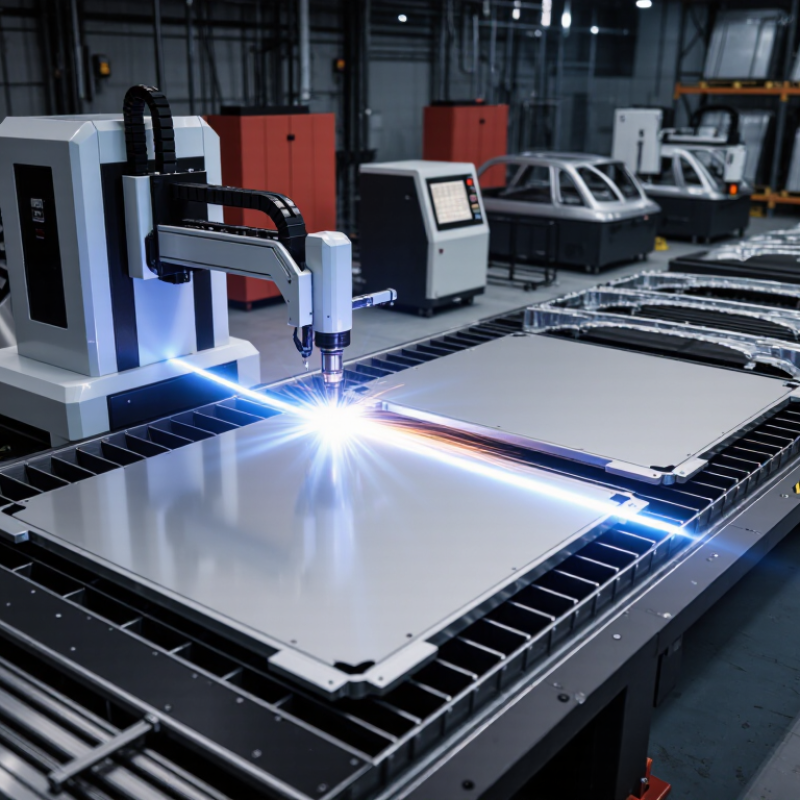
Choosing a laser welding machine for aluminum in 2026 starts with the material, not advertised power. Fiber lasers handle many continuous seams and suit automated production. Pulsed lasers offer tighter heat control for thin sheets, corners, and repairs. Green-wavelength systems can improve aluminum absorption, especially on reflective surfaces. They usually demand higher investment and careful process validation.
Aluminum reflects near-infrared energy and conducts heat rapidly. The weld pool can collapse before penetration becomes stable. Its oxide layer melts at a much higher temperature than the base metal. Clean the joint mechanically and chemically, then protect it from renewed contamination. Even fingerprints can affect consistency. Porosity remains a serious concern when hydrogen enters through moisture, oil, or dirty shielding gas.
Joint fit-up matters more than many parameter charts suggest. Keep gaps small and clamping firm, but avoid excessive restraint. Use suitable shielding gas coverage around the torch and trailing zone. A camera can monitor the seam, yet it cannot replace cross-section testing. In shop trials, changing travel speed by a small amount can alter penetration noticeably. Perfect settings are rarely perfect for every alloy or thickness. That limitation deserves attention. Test representative coupons, inspect the weld profile, and record failed settings instead of hiding them.
2026 Top Types of Laser Welding Machines for Aluminum? – Laser Welding Challenges and Aluminum Material Considerations
| Machine Type | Typical Laser Source and Wavelength | Typical Power Range | Suitable Aluminum Applications | Typical Material Capability | Main Advantages | Key Aluminum Welding Challenges | Important Process Controls |
|---|---|---|---|---|---|---|---|
| Continuous-Wave Fiber Laser Welding Machine | Near-infrared fiber laser, generally 1030–1080 nm | 1–6 kW for common industrial systems | Battery enclosures, heat exchangers, automotive parts, frames, profiles, and sheet-metal assemblies | Approximately 0.5–8 mm, depending on alloy, joint design, power, speed, and penetration requirements | High electrical efficiency, small heat-affected zone, fast travel speed, good automation compatibility, and low maintenance | High reflectivity at near-infrared wavelengths, unstable keyhole behavior, porosity from hydrogen, hot cracking, and sensitivity to joint gaps | Beam power, focus position, travel speed, shielding-gas flow, beam oscillation, clamping, and surface cleaning |
| Handheld Fiber Laser Welder | Near-infrared fiber laser, generally 1064–1080 nm | 1–3 kW is common for portable production systems | Repair work, low-to-medium-volume fabrication, aluminum cabinets, frames, tanks, furniture, and customized assemblies | Approximately 0.5–6 mm for many butt, lap, and fillet joints | Flexible setup, fast learning curve compared with manual arc welding, low distortion, and reduced post-weld finishing | Operator-dependent consistency, limited access to complex joints, laser-reflection safety risks, and difficulty maintaining a uniform stand-off distance | Wire-feed rate, wobble width, focal position, travel speed, shielding coverage, protective eyewear, interlocks, and controlled work-cell access |
| Robotic Fiber Laser Welding Cell | Continuous-wave fiber laser, generally 1030–1080 nm, integrated with a robot and positioner | 2–6 kW for medium- and high-volume production | Automotive structures, electric-vehicle components, aluminum trays, large frames, and repeated weld geometries | Approximately 1–10 mm, subject to joint configuration and heat-management strategy | Repeatable positioning, high throughput, integrated inspection, programmable beam oscillation, and reduced operator exposure | Fixture tolerances, thermal distortion over long welds, fit-up variation, porosity, and the need for reliable seam tracking | Robot path accuracy, adaptive seam tracking, fixture stiffness, synchronized positioners, real-time power modulation, and shielding-gas monitoring |
| Pulsed Nd:YAG Laser Welding Machine | Pulsed solid-state laser, commonly around 1064 nm | Approximately 100–500 W average power; substantially higher peak power during pulses | Thin aluminum parts, precision components, electronics housings, small repairs, and delicate assemblies | Thin sheet and localized welds, commonly below approximately 2 mm | Precise heat input, low overall distortion, controlled spot welding, and good access to small features | Lower productivity on long seams, reflectivity, oxide contamination, porosity, and limited penetration in thicker sections | Pulse energy, pulse duration, repetition rate, spot diameter, overlap percentage, and strict oxide-removal procedures |
| Blue Laser Welding Machine | Visible blue diode laser, commonly around 445– blue 455 nm | Approximately 0.5–3 kW in emerging industrial aluminum applications | Reflective aluminum parts, copper-aluminum connections, battery components, and applications requiring stable surface coupling | Thin to medium sections; final capability depends strongly on alloy, optics, joint design, and available power | Generally improved absorption by aluminum compared with near-infrared wavelengths, potentially reducing process instability and spatter | Higher equipment cost, limited industrial availability, heat accumulation, changing absorptivity during melting, and evolving process standards | Thermal management, focal position, power density, shielding gas, surface condition, and validated parameter windows for each alloy |
| Laser-Arc Hybrid Welding System | Fiber or diode laser combined with GMAW/MIG or another arc process | Laser power commonly 3–10 kW plus an independently controlled arc | Thick aluminum structures, shipbuilding, rail vehicles, transportation frames, and long production seams | Approximately 3–15 mm or more in suitable joint designs and multi-pass arrangements | Greater joint-gap tolerance, high deposition rate, deep penetration, and improved suitability for thicker materials | More complex setup, higher heat input than laser-only welding, arc instability, porosity, hot cracking, and increased qualification requirements | Laser-to-arc distance, wire type and feed rate, arc current, travel speed, shielding-gas mixture, preheating, and interpass temperature |
| Diode Laser Welding Machine | Direct diode laser, commonly around 900–980 nm; specialized blue diode sources may also be used | 1–8 kW, depending on beam quality and application | Broad, shallow welds, aluminum sheet assemblies, sealing operations, cladding, and heat-sensitive components | Approximately 0.5–5 mm for many conduction-mode and shallow-penetration applications | Large rectangular spots, even energy distribution, good surface coverage, and suitability for heat-conduction welding | Lower beam intensity than many fiber systems, limited deep penetration, reflectivity, and possible thermal distortion over wide weld zones | Spot size, power density, travel speed, overlap, cooling, shielding-gas coverage, and control of heat accumulation |
| Laser Welding Machine with Wire or Powder Filler | Usually a continuous-wave fiber or diode laser, with aluminum filler wire or powder | 1–6 kW for common repair, gap-bridging, and deposition applications | Worn-part repair, die and mold restoration, gap compensation, dissimilar joints, and thicker aluminum assemblies | Thin to thick sections, depending on deposition rate, number of passes, and substrate heat management | Improves gap tolerance, allows alloy matching, supports controlled reinforcement, and can reduce machining or rework | Wire feeding and wetting stability, oxide contamination, porosity, hot cracking, dilution, and filler-alloy compatibility | Wire angle, feed rate, laser offset, deposition rate, shielding gas, substrate temperature, and filler-metal selection |
Related Posts
-
10 Essential Tips for Laser Welding Aluminum Successfully
-
Top 10 Tips for Laser Welding Aluminum Effectively?
-
Exploring the Future: How Handheld Laser Welders Are Revolutionizing DIY Projects
-
What is a Part Marking Machine and How Does It Work?
-
How to Choose the Best Handheld Laser Welding Machine for Your Needs?
-
2026 Best Argon Gas for TIG Welding What You Need to Know?